본문
Proposed Amendments to E-Commerce Act Enforcement Decree Clarify Domestic Representative Regime for Foreign Businesses
- Newsletters
- 2026.03.16
On March 11, 2026, the Korea Fair Trade Commission (“KFTC”) published for public comment the proposed amendments to the Enforcement Decree of Korea’s Act on the Consumer Protection in Electronic Commerce, Etc. (the “Proposed Amendments”). For the first time, the proposal sets out the thresholds governing the domestic representative requirement, a matter the Act on the Consumer Protection in Electronic Commerce, Etc. (the “E-Commerce Act”) delegated to its Enforcement Decree. Under the Proposed Amendments, foreign businesses with no address or place of business in Korea will be required to appoint a domestic representative in Korea if, among other things, such foreign businesses had (i) total revenue for the preceding year was at least KRW 1 trillion (approx. USD 670 million) or (ii) average monthly number of Korean consumers accessing their websites or other online storefronts during the three months immediately preceding the end of the prior year was at least one million. Therefore, foreign businesses with no address or place of business in Korea should promptly determine whether they fall within the scope of the new obligation and establish a compliance framework before the effective date of January 21, 2027.
1. Background
2. Criteria for Appointment of a Domestic Representative and Post-Appointment Procedures
3. Role of the Domestic Representative and Allocation of Legal Responsibility
4. Sanctions for Non-Compliance
5. Takeaways
1. Background
The amendments to the E-Commerce Act, passed by the National Assembly plenary session on December 30, 2025, made it mandatory for certain foreign businesses above a specified size to appoint a representative in Korea, against the backdrop of growing cross-border e-commerce activity and the resulting increase in consumer harm. Although the amended statute was promulgated on January 20, 2026, the applicable criteria for determining which businesses are subject to the domestic representative requirement had been left to the Enforcement Decree of the E-Commerce Act, making it difficult for companies to assess whether they were covered by the obligation. With the Proposed Amendments now published for public comment from March 11, 2026 to April 20, 2026, those criteria have been disclosed for the first time, enabling affected businesses to begin preparing concrete compliance plans and response systems.
2. Criteria for Appointment of a Domestic Representative and Post-Appointment Procedures
The Proposed Amendments set forth the following three criteria for foreign online sellers or online platform intermediaries with no address or place of business in Korea that are required to appoint a domestic representative. The obligation arises if any one of these criteria is satisfied:
(1) Revenue Threshold
• A business whose total revenue for the preceding year (or, in the case of a corporation, the immediately preceding fiscal year) was at least KRW 1 trillion
• Revenue is to be converted into Korean won using the average exchange rate for the preceding year
(2) Korean User Threshold
• A business whose average monthly number of Korean consumers accessing its website or other online storefront during the three months immediately preceding the end of the prior year was at least one million
(3) KFTC Document Request Trigger
• A business that has received a request from the KFTC for a report or for the submission of materials or objects where consumer harm has occurred, or is likely to occur, as a result of a violation of the E-Commerce Act
In addition, the Proposed Amendments specify the procedures to be followed after appointment of a domestic representative.
• A business that has appointed a domestic representative must, without delay after such appointment, submit relevant information to the KFTC in writing, including the representative’s name, address, telephone number, and email address, and must disclose such information on the first page of the website or other online storefront that it operates.
• In addition, where a foreign business has a Korean entity that it has established or over which it exercises controlling influence with respect to the composition of officers, business operations, or similar matters, that Korean entity must be designated as the domestic representative.
3. Role of the Domestic Representative and Allocation of Legal Responsibility
Under the amended E-Commerce Act, the domestic representative is the person or entity that performs certain statutory obligations in Korea on behalf of the foreign business. Specifically, the domestic representative is responsible for matters relating to consumer redress, handling consumer complaints or disputes, and implementation of measures relating to KFTC investigations. Accordingly, the domestic representative is not merely a passive recipient of communications for the foreign business, but is expected to perform substantive functions relating to consumer protection and responses to KFTC investigations.
The amended E-Commerce Act also expressly addresses attribution of responsibility for the acts of the domestic representative. If the domestic representative violates the E-Commerce Act in connection with the foregoing representative functions, the foreign business that appointed the domestic representative is deemed to have committed the violation.
4. Sanctions for Non-Compliance
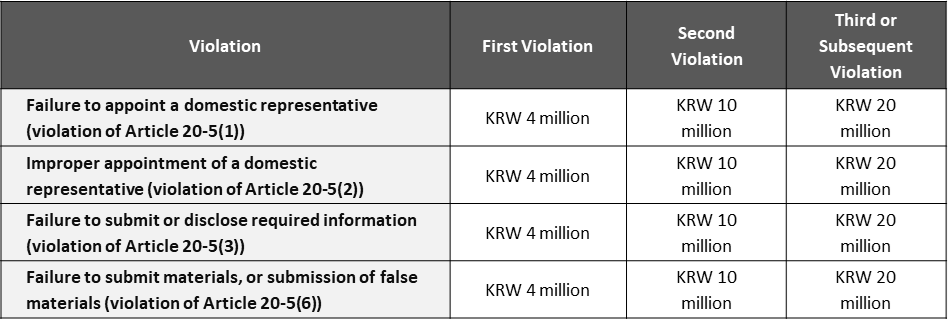
The E-Commerce Act and the Proposed Amendments provide for the following sanctions for violations of obligations relating to domestic representatives:
A. Administrative Fine Schedule
B. Business Suspension Standards
In the event of failure to appoint a domestic representative, improper appointment of a domestic representative, failure to submit or disclose required information, or failure to maintain valid means of communication, a business may be subject, in addition to a corrective order, to suspension of business for three months for a first violation, six months for a second violation, and twelve months for a third or subsequent violation.
5. Takeaways
Now that the criteria for appointment of a domestic representative have been clarified through the Proposed Amendments, foreign businesses with no address or place of business in Korea should keep the following points in mind.
First, businesses should promptly assess whether the domestic representative requirement applies to them. That analysis should begin with the threshold tests set out in the proposed amendments, including whether total revenue for the preceding year was at least KRW 1 trillion or whether the average monthly number of Korean consumers accessing the business’s website or other online storefront during the three months immediately preceding the end of the prior year was at least one million. In addition, where a foreign business has a Korean entity that it established or over which it exercises controlling influence, that Korean entity must be designated as the domestic representative. As a result, the scope analysis should include a review of the group’s Korean corporate structure, rather than focusing solely on revenue and user metrics.
Second, foreign businesses that may be covered should establish the domestic representative’s operating framework at an early stage. The representative will be expected to handle matters relating to consumer redress, consumer complaints and disputes, and responses to KFTC investigations, and any violation by the domestic representative in performing those functions will be attributed to the appointing foreign business. Accordingly, businesses should clearly define in advance the representative’s authority and responsibilities, reporting and approval lines with headquarters, and internal processes for handling consumer complaints and regulatory inquiries.
Third, businesses should prepare a roadmap aligned with the implementation timeline. The domestic representative regime itself will take effect on January 21, 2027, and the Proposed Amendment’s sanctions for business suspension and administrative fines are scheduled to take effect on February 21, 2027. Given the time that may be required to assess applicability, designate the appropriate representative, and build the necessary internal processes, foreign businesses that may be covered would be well advised to begin phased preparations now.
The Proposed Amendments appear likely to mark a significant step toward more effective Korean enforcement against foreign e-commerce businesses that have historically been beyond the reach of regulators. Foreign online sellers and online platform intermediaries operating at scale in Korea should therefore carefully assess both whether the new regime applies and what compliance measures will be needed for effective implementation.
Yoon & Yang’s Antitrust & Competition Group comprises more than 50 dedicated professionals who specialize in all areas of antitrust law, including the Monopoly Regulation and Fair Trade Act, the Fair Subcontracting Transactions Act, the Fair Franchise Transactions Act, and the Fair Transactions in Large Retail Business Act. Our team provides comprehensive, one-stop services encompassing advisory work including compliance audits, responses to KFTC investigations, as well as representation in administrative, criminal, and civil litigation. Should you require assistance in any aspect of antitrust or competition law, please contact us or visit our website at www.yoonyang.com.
- Practice Areas
- #Antitrust & Competition