본문
The Rise of AI Infrastructure Investments: Are Data Centers an Opportunity or a Risk?
- Newsletters
- 2026.07.09
With the rapid acceleration of AI adoption following the launch of ChatGPT, data centers are emerging as a key alternative asset class for institutional investors, joining offices and logistics as a major investment category. Data centers have become increasingly attractive investments due to the surge in hyperscaler capital expenditures, vacancy rates of less than 1%, and stable long-term lease structures. Yet this asset class presents legal and operational risks that differ fundamentally from those associated with traditional commercial real estate. Entering the market without a clear understanding of these risks could expose investors to an entirely new set of challenges. This newsletter examines the current landscape of data center real estate investment, its unique structural characteristics, the principal legal risks facing institutional investors, and the critical role of legal counsel in mitigating those risks.
1. Why Data Centers, and Why Now?
Unprecedented Demand and the Influx of Institutional Capital
2. Key Legal and Operational Risks Facing Institutional Investors
3. The Role of Korean Legal Counsel: A Stage-by-Stage Legal Strategy
1. Why Data Centers, and Why Now?
Unprecedented Demand and the Influx of Institutional Capital
As exponential demand for AI training and inference continues to outpace capacity, data centers have become solidified their state as the critical physical infrastructure underpinning the digital economy. According to the JLL’s 2026 Global Data Center Market Outlook, the global sector is projected to grow at 14% CAGR through 2030, nearly doubling its current size. This expansion demands staggering capital, with total investment requirement estimated at up to $3 trillion over the next four years.
Driven by this momentum, the top five leading hyperscalers—Amazon, Microsoft, Meta, Google, and Oracle—are expected to deploy approximately $710 billion in capital expenditure (CapEx) in 2026 alone. This capital influx comes at a time of extreme supply constraints; the date center vacancy rate in North America has hit a historic low of 1% for the second consecutive year, underscoring an acute supply-demand mismatch.
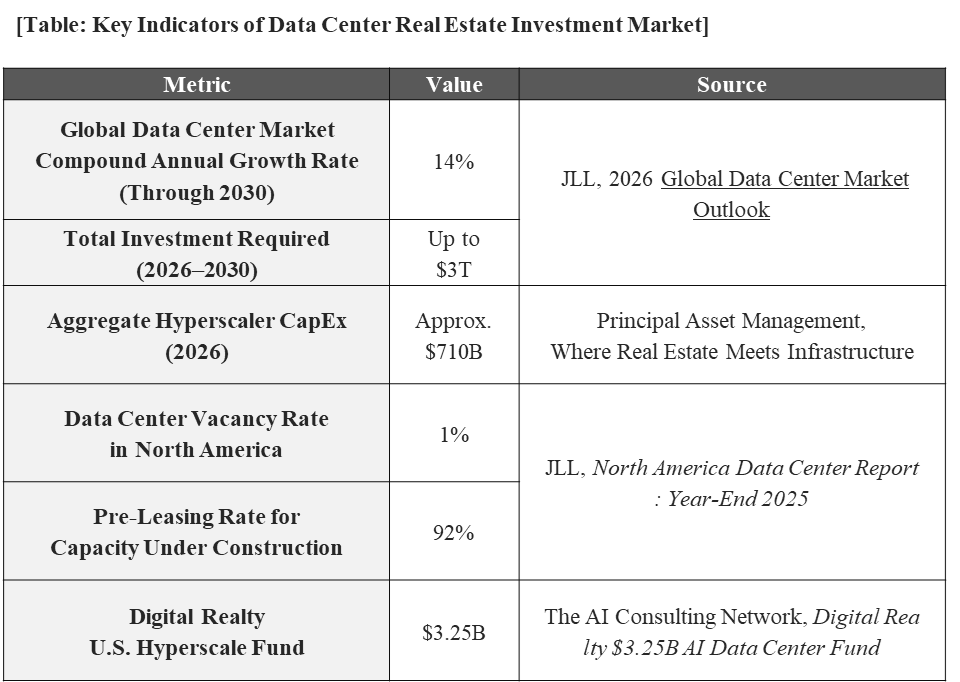
Moreover, institutional capital is flooding the sector. In March 2026, Digital Realty completed the formation of a $3.25 billion U.S. hyperscale data center fund, drawing commitments from top-tier global pension funds, sovereign wealth funds, and insurance companies. Similarly, Blackstone has amassed a massive data center portfolio exceeding $70 billion through its landmark acquisition and subsequent expansion of QTS Realty Trust.
This momentum extends to the South Korean market, where the Canada Pension Plan Investment Board (CPPIB) recently anchored KRW 1 trillion domestic data center development project. Notably, the asset class is also attracting policy-driven financing; the National Growth Fund is reportedly evaluating a KRW 400 billion low-interest loan for Naver's Sejong data center facility (source: Data Center News Weekly Update, Third Week of April 2026, https://maily.so/datacenternews/posts/1do1dq3xox6).
A Hybrid Asset Class Demanding a New Legal Framework
Despite this capital rush, data centers diverge fundamentally from traditional commercial real estate. They are complex, hybrid assets blending real estate, critical infrastructure, and advanced technology. Consequently, they introduce unique regulatory, operational, and legal risks that traditional real estate investment frameworks fail to capture. Institutional investors must navigate these distinct complexities, which we examine in the following sections.
2. Key Legal and Operational Risks Facing Institutional Investors
A. Power Supply Risks: The Defining Factor in Data Center Investment
While location dictates traditional real estate investment, power supply reigns supreme in data center sector. According to JLL, securing a grid connection in North America now takes an average of over four years. Consequently, power availability has become the definitive metric for site selection, leasing velocity, and pricing.
Data centers typically secure baseline power through Electricity Supply Agreements (ESAs) with grid operators—such as the Korea Electric Power Corporation (domestic) domestically. To meet carbon neutrality targets and hedge against long-term volatility, an increasing number of operators also enter into separate Power Purchase Agreements (PPAs) with renewable energy producers. Whitin this framework, institutional investors face four distinct power-related risks vectors:
✓ Generation Mismatch Under PPAs: The intermittent nature of renewable energy sources (e.g., solar and wind power) creates inherent supply volatility. When the hours during which a renewable energy producer generates power do not match the hours during which a data center consumes electricity, the operator must procure the shortfall from market at a premium. Clear contractual mechanisms are required to define which party absorbs these additional procurement costs.
✓ Curtailment Domino Effect: Grid operators may unilaterally mandate curtailment to prevent grid overload, rendering the producer unable to deliver the contracted volume. This triggers a dual-layer dispute:
1. PPA Dispute: When shortfall constitutes a Force Majeure event relieving the producer of liability, and whether the operator can claim reimbursement for spot-market coverage.
2. SLA Dispute: Data center operators are bound by stringent Service Level Agreements (SLAs) with hyperscaler tenants. If curtailment destabilizes power availability, the operator risks breaching these SLAs, triggering substantial indemnity claims
✓ Regulatory Change-in-Law Risks: Spanning 10 to 20 years, long-term PPAs are highly vulnerable to regulatory shifts that compress Net Operating Income (NOI). A notable example in Korea is the power system impact assessment introduced in 2024, which retroactively burdened existing projects with unforeseen compliance costs. Prior to commitment, investors must carefully scrutinize the change-in-law provisions to ensure robust cost-allocation mechanisms.
B. Hyperscaler Tenant Concentration Risks: The Double-Edged Nature of Take-or-Pay Structures
Data center tenancy is highly concentrated among a handful of hyperscalers—namely AWS, Google, Microsoft, Meta, and Oracle—who command approximately 70% of all new leasing activity. While their investment grade credit profiles mitigate traditional default risk, their dominant footprint introduces an acute binary risk. The highly specialized nature of AI-optimized facilities means that a single tenant’s exit or non-renewal can instantly render an asset non-income producing, requiring tens of millions of dollars in capital expenditures (CapEx) for retrofitting to attract a replacement.
To mitigate this, developers increasingly rely on take-or-pay lease structures. Under this structure, tenants are obligated to pay rent for contracted capacity regardless of actual utilization. This framework—historically common in energy infrastructure—has seen massive adoption in the U.S., evidenced by Applied Digital’s 15-year, $15 billion lease a Hut 8’s 15-year, $9.8 billion contract. While this framework appears to provide investors with stable and predictable cash flows, these seemingly stable cash flows expose landlords to latent vulnerabilities, given the blistering pace of AI technological shifts and the formidable negotiating power of hyperscalers:
✓ Strategic Termination Rights: Hyperscalers routinely negotiate and exercise termination rights ties to technological obsolescence or shifts in corporate strategy. A stark example occurred in early 2025, Microsoft reportedly cancelled lease agreements covering hundreds of megawatts of capacity across the United States, directly impacting investor capital recovery timeline.
✓ Invoking Hardship or Material Adverse Change (MAC) Clauses: A severe deflation in AI computing costs can trigger lease disputes. Hyperscalers lease capacity to deploy GPU clusters and monetize computing services. However, as infrastructure scaled, the market experienced a supply-side shock: by end-2025, the hourly rental rate for NVIDIA H100 GPUs plummeted by approximately 78% from its 2023 peak. Faced with severely compressed margins, hyperscalers stuck in legacy, high-rent long-term leases may seek judicial or arbitral relief under hardship, rebus sic stantibus (change of circumstances), or force majeure provisions to force a price renegotiation.
C. Technological Obsolescence
Unlike traditional infrastructure assets (such as LNG terminals or conventional power plants) that enjoy predictable 20-to-30-year useful lives, data centers face rapid technological obsolescence. Generational shifts in GPU architecture (from H100 to H200, B200, and the upcoming Vera Rubin architecture) occur every 12 to 18 months. Each iteration exponentially increases power density requirements, shifting from historical baselines of 10–15 kW per rack to over 80–120 kW per rack for AI workloads, which mandates an immediate transition to liquid cooling. Institutional investors must safeguard their returns against this obsolescence through two critical lease mechanisms:
✓ PUE Cap Erosion: Power Usage Effectiveness (PUE) caps shift the financial burden of operational and cooling inefficiencies directly to the landlord. If a facility's efficiency drops below the agreed benchmark, the resulting excess power costs dollar-for-dollar erode the landlord’s Net Operating Income (NOI).
Retrofit Cost Allocation: If a long-term lease (15 to 20 years) fails to explicitly allocate the CapEx required for technological upgrades, tenants gain immense leverage upon expiration. They can demand drastic rent reductions or force the landlord to absorb modernization costs on the grounds that the facility is no longer technologically viable.
D. Complex Financing Structure Risks
The capital stacks for AI data center investments have outgrown traditional commercial real estate financing. Given the scale required to fund the real estate (shell), power infrastructure (facilities), and GPU clusters (technology) simultaneously, developers rely on highly complex, cross-collateralized structures. These interlock senior bank debt, GPU-backed private credit facilities, and asset-backed securities (ABS) structured around lease receivables.
These multilayered structures carry the risk of cascading defaults. Most data center financing agreements contain cross-default provisions, meaning that an event of default (EOD) at one facility— for example, resulting from a tenant’s failure to pay rent—may trigger corresponding EODs under other financing arrangements entered into by the same borrower. Particularly where a data center operator owns or operates multiple facilities, a problem arising at a single facility can destabilize the operator’s entire financing structure, thereby materially impairing investors’ ability to recover their investments.
E. Asset Overvaluation and R&W Claim Risks
A common investment structure in the data center sector involves a developer drop-shipping a completed data center asset into a special purpose vehicle (SPV), injecting equity or debt financing to the SPV. In such cases, developers may transfer assets at inflated valuations by portraying facilities as stabilized, cash-generating assets. In reality, these may be “booked-but-not-billing” assets that have not yet secured binding tenant commitments, or facilities lacking fully cleared power availability.
If investors subsequently discover that the transferred asset diverges from the representations and warranties (R&Ws) executed at closing, they may pursue contractual claims against the developer. However, R&W litigation provides only an ex-post remedy once losses have materialized. Accordingly, it is critical to independently verify, prior to investment, the status of tenant commitments, power availability, and the reasonableness of the asset valuation.
F. Regulatory and Permitting Risks: Local Opposition and Environmental Constraints
Data centers increasingly faces severe local community backlash driven by massive consumption of electricity and water, alongside noise and thermal emissions. In April 2026, the state of Maine became the first in the United States to pass a statewide ban on data center construction, with more than ten other states considering similar measures.
Conversely, Korea is adopting a deregulatory approach via the Special Act on Support for AI Data Centers, passed by the National Assembly in May 2026. This legislation introduces a permitting review deadline and expans exemptions from the power system impact assessment for non-metropolitan projects. However, acute regulatory uncertainty persists as the Enforcement Decree is not expected to be promulgated until late 2026 or early 2027. Without thorough pre-investment due diligence on the target asset’s zoning status, whether conditional use permits have been obtained, and the risk of development moratoriums (e.g., temporary moratoria on data center development imposed by local governments), development approvals may ultimately be revoked or delayed after the investment has been made.
3. The Role of Korean Legal Counsel: A Stage-by-Stage Legal Strategy
Unlike traditional commercial real estate, data center investments require highly specialized expertise at the intersection of real estate law, energy regulation, technology contracting, and complex financing structures. The power supply, tenant concentration, technological, and regulatory risks discussed above are highly interconnected and rarely arise in isolation. The materialization of any one of these risks can trigger or exacerbate the others. Accordingly, without specialized legal advice at each stage of the investment, investors may find it difficult to proactively mitigate losses arising from the failure to secure power supply, tenant attrition, technological obsolescence, or changes in law.
Drawing on extensive experience across domestic and cross-border real estate fund investments and financial transactions, Yoon & Yang LLC’s Alternative Investment Practice Group is committed to providing comprehensive legal services throughout the entire lifecycle of data center investments, including the following:
[STAGE 1. Pre-Investment Review: Legal Due Diligence]
While traditional real estate diligence predominantly focuses on title, zoning and phase -I environmental issues, data center investments require a broader review:
• Power Supply: Review of (i) the execution and terms of the ESA; (ii) the reliability of power supply under the PPA; and (iii) provisions addressing generation mismatch, curtailment, and changes in law, including the associated cost-allocation mechanisms.
• Contractual Arrangements: Analysis of (i) the scope of take-or-pay obligations under lease agreements; (ii) the circumstances in which tenants may exercise termination rights and the amount of any applicable termination fees or penalties; and (iii) PUE Cap provisions and the allocation of retrofit costs.
• Financing Structures: Independent verification of (i) the scope of any cross-default provisions; and (ii) in connection with asset transfers through an SPV, whether the tenant commitments, power availability, and asset valuation conform to the applicable representations and warranties.
• Regulatory Matters: Confirmation of (i) the asset’s zoning status and whether the necessary conditional use permits have been obtained; (ii) whether any development moratorium has been proposed or is under consideration by local authorities; and (iii) for domestic assets, whether the asset is expected to benefit from the incentives under the Special Act on Support for AI Data Centers, following the promulgation of the Enforcement Decree.
Yoon & Yang LLC’s Alternative Investment Practice Group identifies legal risks specific to data centers at an early stage and provides tailored guidance, thereby supporting accurate investment decision-making and proactively mitigating losses.
[STAGE 2. Contract Negotiation: Structuring Investor Protection Provisions]
The ultimate financial performance of a data center investment is dictated by the precise calibration of its core contractual framework.. Yoon & Yang LLC’s Alternative Investment Practice Group protects institutional investors by (i) reviewing, during the pre-investment due diligence stage, whether key agreements entered into by the SPV include adequate investor protection provisions, and (ii) assisting, during the LPA (Limited Partnership Agreement) negotiation stage, in the inclusion of provisions requiring the GP (General Partner) to satisfy specified contractual conditions. Key review items include:
• Power Availability: Whether securing grid connection capacity is expressly designated as a condition precedent under the grid connection agreement and whether termination rights are available if specified project milestones are not achieved.
• PPA Cost Allocation: Whether the PPA clearly allocates costs arising from generation mismatch, curtailment, and changes in law.
• Termination Rights and Remedies: Whether the circumstances under which a tenant may exercise termination rights and the applicable termination fees, or liquidated damages provide sufficient protection for investors.
• Force Majeure Exclusions: Whether technological changes and declines in AI demand are expressly excluded from the scope of force majeure provisions.
• PUE Cap and Excess Cost Allocation: Whether the PUE Cap and the associated cost allocation mechanism are structured in a manner that does not disproportionately disadvantage the landlord.
• Retrofit Cost Allocation: Whether responsibility for retrofit costs is clearly allocated between the parties.
[STAGE 3. Post-Investment Management: Regulatory Monitoring and Dispute Prevention]
The legal work associated with data center investments does not end at closing and requires continuous monitoring thereafter. At this stage, Yoon & Yang LLC ‘s Alternative Investment Practice Group provides the following services:
• Regulatory Monitoring: (i) confirming whether the relevant asset benefits from the incentives under the Special Act on Support for AI Data Centers and analyzing the impact of the implementing Enforcement Decree on existing contracts following its promulgation; and (ii) monitoring subsequent regulatory developments relating to the power system impact assessment and reviewing the applicability of relevant contractual provisions in light of such developments.
• Dispute Prevention: (i) developing legal strategies to address a tenant's attempt to terminate a lease or renegotiate rent; (ii) analyzing the allocation of liability and implementing preventive measures in interconnected disputes arising from power supply disruptions or construction delays across PPAs, EPC (Engineering, Procurement and Construction) contracts, and SLAs; and (iii) providing legal support in disputes concerning facility upgrade costs arising from hyperscaler tenants' demands for technology upgrades.
As the core component of AI infrastructure, data centers are supported by strong structural growth drivers. However, without a clear understanding of the complex interplay among power, technology, regulatory, and contractual risks, investors may face risks fundamentally different from those encountered in traditional commercial real estate investments.
Drawing on extensive expertise in domestic and cross-border real estate fund investments and financial transactions, Yoon & Yang LLC’s Alternative Investment Practice Group is well positioned to provide practical and strategic legal services throughout every stage of data center investments—from legal due diligence and contract negotiations to regulatory monitoring and dispute prevention.
- Practice Areas
- #Real Estate Financing ∙ Investing
Professionals



Previous
GRAC Steps Up Enforcement Against Overseas Game Companies: Key Takeaways from the Domestic Representative Briefing Session
Next
Yoon & Yang Wins Final Supreme Court Confirmation in a Global SaaS Corporate Income Tax Case Software and Service Fees Paid to a Foreign SaaS company Held to Be Business Income, Not Royalties — Full Refund of Withholding Tax Confirmed